
Executive Summary
Water is one of our most precious natural resources. In Pakistan, increasing water scarcity makes conservation an urgent environmental and social priority.
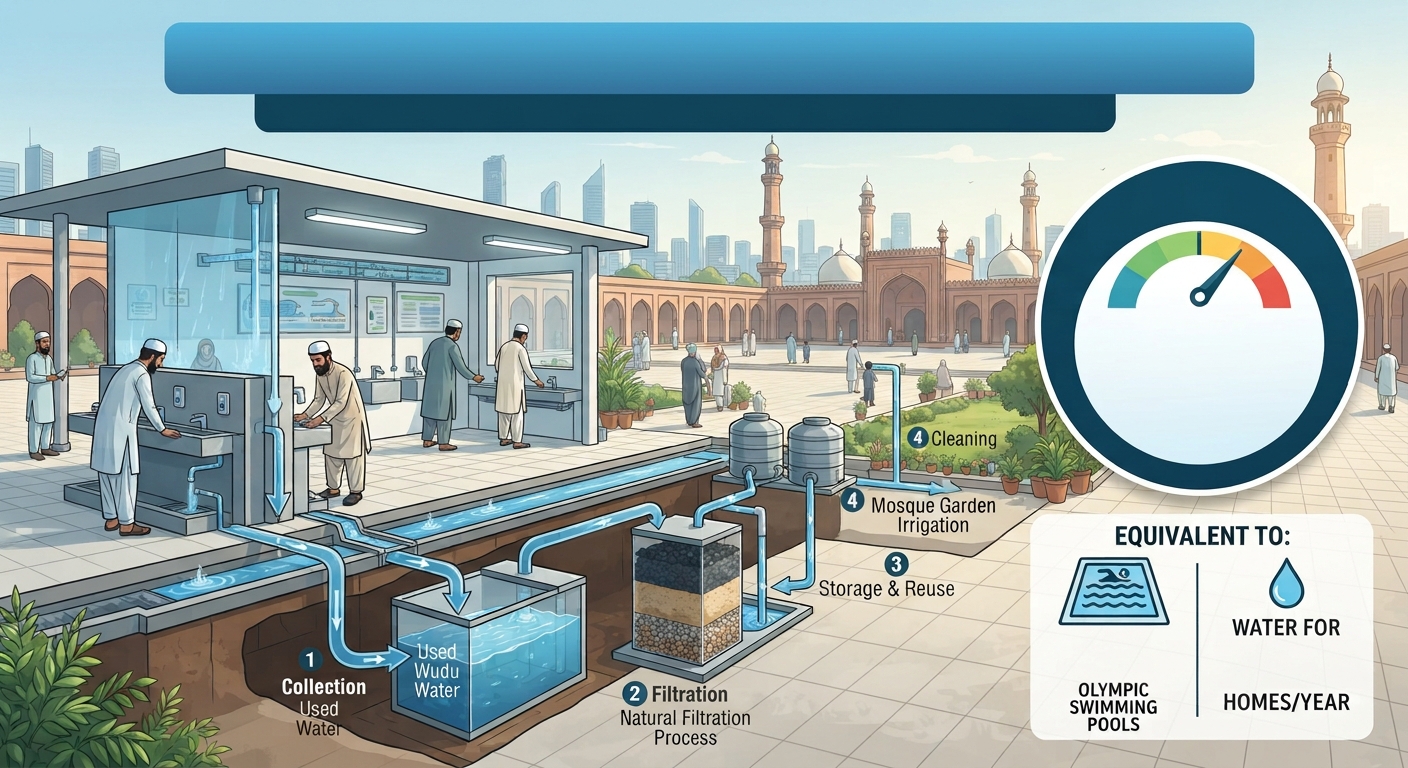
Every day, millions of Muslims perform ablution (wudu) before offering prayers. Although ablution is an essential religious practice, unnecessary water flow during washing can result in substantial water wastage when repeated across large numbers of worshippers.
HFT Pakistan proposes to promote a practical and scalable water-conservation initiative focused on reducing unnecessary water consumption during ablution in mosques and community facilities.
The initiative will combine water-efficient equipment where appropriate, public awareness, mosque partnerships, water-use assessments and impact monitoring.
Our mission is to save millions of litres of water, protect our environment and inspire communities to become responsible water stewards.
Where previous water-saving work has already been undertaken, HFT Pakistan will document the activities, participating sites and evidence of water savings to establish a credible project impact report.
Background and Need
Pakistan faces increasing pressure on its freshwater resources due to population growth, urbanization, changing rainfall patterns and rising water demand.
Water conservation requires action not only in agriculture and industry but also in homes, mosques, schools, offices and public buildings.
Mosques offer a valuable opportunity to promote water awareness because they bring communities together regularly. Small reductions in water use per person can create significant cumulative savings when adopted by many worshippers.
This project aims to make responsible ablution a practical, measurable and widely adopted water-conservation practice.
Assess existing ablution areas and identify opportunities to reduce water consumption. Depending on local conditions, interventions may include low-flow taps, flow restrictors, push-button taps, leak repairs and other suitable water-saving devices.
Equipment must provide adequate flow, remain hygienic and be appropriate for the site’s plumbing and users.
Develop educational materials in Urdu and regional languages, including posters, banners, social media content and short awareness videos.
Key message: “Perform Wudu with care. Save water. Protect life.”
Invite mosque committees and religious leaders to participate voluntarily. Provide practical guidance on reducing unnecessary running water and maintaining efficient facilities.
Record water consumption at participating sites before and after interventions wherever reliable measurement is possible.
Use water meters, documented flow-rate tests, tap-use observations and operating records to calculate savings.
Involve students, volunteers, community groups and environmental organizations in awareness activities and periodic reporting.
Maintain a record of participating mosques, intervention dates, equipment installed, monitoring periods, water savings and maintenance requirements.
Water savings must be based on measurements or clearly stated assumptions.
For example:
Water saved per day = reduction in average water use per ablution × number of ablutions per day.
Estimated annual savings = daily water savings × operating days per year.
Illustrative example only: If an intervention saves an average of 1 litre per ablution, and a mosque records 500 ablutions per day, the estimated saving is 500 litres daily, or 182,500 litres over 365 days.
Actual savings will vary by site and must be verified. Results from individual mosques should not be extrapolated to the entire country without supporting evidence.
Phase 1 — Documentation and Assessment
Phase 2 — Pilot Programme
Phase 3 — Monitoring and Evaluation
Phase 4 — Expansion and Partnerships
The programme will track:
HFT Pakistan welcomes collaboration with:
Potential support may include funding, equipment, technical expertise, monitoring systems, awareness materials and access to participating sites.
A detailed budget will be prepared after identifying the number of participating mosques and assessing their requirements.
Budget categories may include:
All costs will be supported by quotations and documented project requirements.
The project will prioritize durable, repairable equipment, local technical support and the training of mosque representatives.
Participating sites will be encouraged to maintain equipment, monitor water use and continue awareness activities after the initial project period.
Where suitable and legally permissible, partnerships with businesses and CSR sponsors can help cover installation and maintenance costs.
The proposed programme aims to:
The number of mosques, target savings and project-wide outcomes will be finalized after the baseline assessment and funding confirmation.
HFT Pakistan invites government institutions, mosque administrations, corporate CSR partners, donors and environmental organizations to join this water-conservation initiative.
Together, we can turn small individual actions into substantial collective savings and help protect Pakistan’s water resources for future generations.
HFT Pakistan — Every Drop Counts. Every Mosque Can Make a Difference.

Happiness Foundation Trust (HFT) is a registered non-governmental organisation headquartered in Pakistan. Founded on the belief that environmental health and human happiness are deeply connected, HFT brings together volunteers, communities, researchers, and policymakers to address the growing threat of climate change across the country.
Copyright © 2026 Happiness Foundation Trust, All rights reserved.